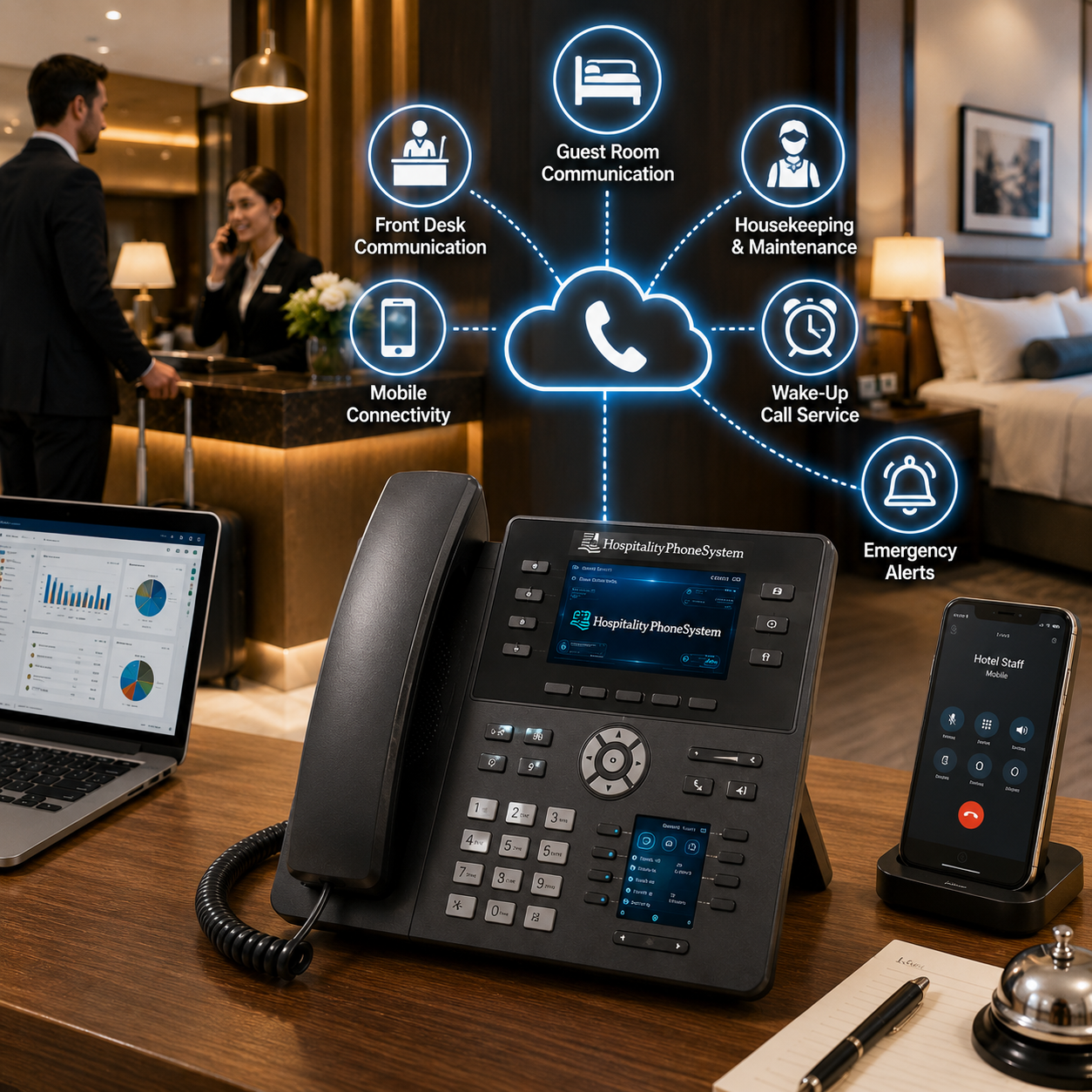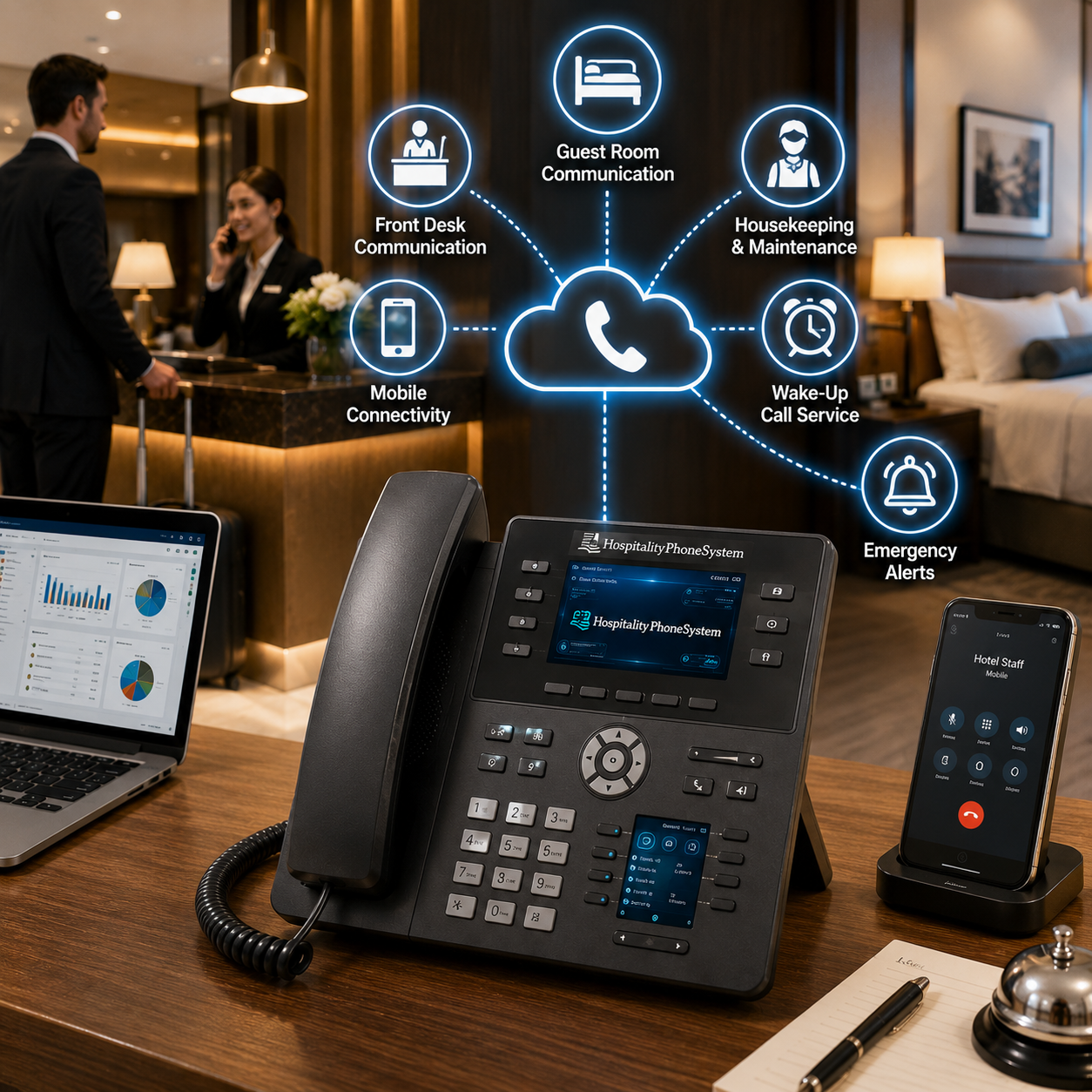
A reliable phone system is still an important part of hotel operations. Guests use phones to contact the front desk, request housekeeping, ask for maintenance, order services, make wake-up-call requests, and communicate with hotel staff. Employees also depend on internal communication between the front desk, housekeeping, maintenance, management, reservations, and other departments.
For many hotels and motels in the United States, however, traditional phone systems are becoming increasingly difficult and expensive to maintain. Older PBX equipment can require specialized hardware, dedicated wiring, on-site maintenance, and costly upgrades. This is where a VoIP phone system can provide a more flexible alternative.
VoIP, or Voice over Internet Protocol, allows voice calls to travel over an IP network rather than relying entirely on traditional telephone infrastructure. Modern business VoIP systems can also combine calling, messaging, voicemail, mobile applications, call management, analytics, and other communication tools within a single platform.
For hotels and motels, the benefits go beyond simply making and receiving calls. A properly designed hotel VoIP phone system can connect guest rooms with the front desk, simplify employee communication, support multiple properties, integrate with hospitality software, improve call management, and provide a scalable communication infrastructure.
This complete guide explains what a VoIP phone system is, how it works, how much it can cost, which features hotels should consider, how cloud PBX differs from traditional PBX, and how to choose the right hotel phone system in the United States.
What Is a VoIP Phone System?
A VoIP phone system is a telephone system that uses an internet protocol network to transmit voice communications. Instead of sending voice calls entirely through traditional telephone circuits, VoIP converts voice into digital data packets and sends them through an IP network.
The Federal Communications Commission describes interconnected VoIP as a service that provides real-time, two-way voice communication, requires a broadband connection and compatible equipment, and allows calls to and from the traditional public switched telephone network.
In practical terms, a hotel can use an internet-connected phone system to manage calls from guest rooms, front desks, offices, reservations departments, management offices, and other areas of the property.
A VoIP environment may include:
- IP desk phones
- Hotel guest-room phones
- Softphones on computers
- Mobile VoIP applications
- Cloud PBX software
- SIP trunks
- VoIP gateways
- Analog telephone adapters
- Call management software
- Hotel PMS integrations
- Internet connectivity and network equipment
Unlike an old-style telephone system where the PBX may depend heavily on physical telephone circuits, modern IP-based communication systems can be centrally managed and expanded through software and network connectivity.
How Does a VoIP Phone System Work?
The basic concept is straightforward.
When someone speaks into a VoIP phone, the system converts the voice into digital information. That information is transmitted through the hotel's IP network and, when necessary, across the internet or a private IP connection to another phone or telephone network.
A typical hotel VoIP setup may look like this:
Guest Room Phone → Hotel Network → VoIP Platform / Cloud PBX → Telephone Network → External Caller
For internal calls, communication may remain within the hotel's network:
Guest Room → IP Network → Hotel PBX → Front Desk Extension
This architecture makes it possible to create extensions for different departments and locations without requiring a separate traditional telephone line for every communication function.
The FCC has also noted that enterprise communication systems have evolved from traditional circuit-switched PBX environments toward IP-based and cloud-based systems.
Why Are Hotels Moving to VoIP Phone Systems?
Hotels have communication requirements that are different from ordinary offices.
A hotel may have hundreds of guest rooms, multiple departments, a 24-hour front desk, housekeeping teams, maintenance personnel, conference facilities, restaurants, parking areas, and sometimes multiple buildings or properties.
The phone system therefore needs to do more than connect two people.
It needs to support the guest experience and hotel operations simultaneously.
Some of the most common reasons hotels consider VoIP include:
- Reducing dependence on aging PBX hardware
- Supporting remote and mobile staff
- Managing multiple hotel locations
- Adding or removing extensions more easily
- Improving call routing
- Supporting hotel-specific calling features
- Integrating with property management systems
- Improving communication between departments
- Supporting modern IP phones
- Using cloud-based administration
- Improving reporting and call visibility
- Creating a scalable communication platform
What Is a Hotel VoIP Phone System?
A hotel VoIP phone system is a VoIP communication platform configured specifically for hospitality operations.
It can connect guest-room phones with the front desk while also providing extensions for housekeeping, maintenance, management, reservations, sales, restaurants, conference rooms, and other hotel departments.
A hotel VoIP system may also support hospitality-specific functions such as:
- Guest room extensions
- Front desk calling
- Wake-up calls
- Do-not-disturb functionality
- Housekeeping communication
- Room status communication
- Call transfer
- Automated attendants
- Voicemail
- Call recording
- Emergency calling
- Guest service communication
- Multi-property management
Hospitality-focused phone platforms can also integrate communication with hotel operational systems. For example, a hotel may want the phone system to communicate with its property management system so that room status, guest information, call charges, or other operational information can be handled more efficiently.
VoIP Phone System vs. Traditional Hotel PBX
Traditional hotel PBX systems have been used for decades. They can still work effectively when properly maintained, but many older systems depend on proprietary hardware, legacy telephone infrastructure, and specialized technical support.
A modern IP-based system moves much of the communication infrastructure onto an IP network.
| Feature | Traditional Hotel PBX | VoIP / Cloud PBX |
|---|---|---|
| Communication network | Traditional telephone infrastructure | IP network / internet |
| Hardware dependency | Often high | Generally lower with cloud systems |
| Scalability | Can require hardware expansion | Often easier to scale |
| Remote access | Limited | Usually supported |
| Mobile applications | Limited or unavailable | Common |
| Cloud management | Usually unavailable | Common with hosted platforms |
| Call analytics | System dependent | Common in modern platforms |
| Multi-location management | Can be complex | Often easier |
| Integration capabilities | System dependent | Usually broader API/software options |
The right choice still depends on the hotel's existing infrastructure, budget, network, phone inventory, operational requirements, and long-term technology strategy.
Cloud PBX vs. On-Premise VoIP for Hotels
Not every VoIP system is completely cloud-based.
Hotels generally have three broad approaches to consider: on-premise IP PBX, hosted or cloud PBX, and hybrid systems.
1. On-Premise IP PBX
An on-premise IP PBX is installed and managed at the hotel property.
The hotel may have greater control over its infrastructure, but it is also responsible for equipment, maintenance, updates, backups, security, and technical management.
2. Cloud PBX
A cloud PBX is hosted by a service provider. The hotel connects phones and users to the hosted communication platform through its network.
This approach can be attractive for hotels that want centralized administration without maintaining a large telephone server at the property.
3. Hybrid Hotel Phone System
A hybrid system combines technologies. A hotel may continue using some analog phones or legacy infrastructure while adding IP phones, SIP connectivity, or cloud services.
This can be useful during a gradual migration because a hotel does not necessarily need to replace every phone and every piece of infrastructure on the first day.
Key Features of a VoIP Phone System for Hotels
The most important part of selecting a hotel phone system is understanding the features that actually support hotel operations.
1. Front Desk Call Management
The front desk is usually the central communication point in a hotel.
A modern phone system should make it easy for front-desk employees to answer calls, transfer calls, place callers on hold, contact departments, and manage multiple incoming calls.
2. Guest Room Extensions
Each guest room can have its own extension or telephone endpoint. Guests can use the phone to call the front desk, housekeeping, room service, maintenance, or other approved hotel departments.
3. Automated Attendant
An automated attendant can answer incoming calls and guide callers to the appropriate department.
For example:
"Thank you for calling our hotel. For reservations, press 1. For the front desk, press 2. For sales, press 3."
This can reduce unnecessary call transfers and help staff manage busy periods.
4. Call Transfer
Hotel employees frequently need to transfer calls between departments. A VoIP system can make this process simple and consistent.
5. Voicemail
Voicemail allows employees and departments to receive messages when calls cannot be answered.
Some systems also support voicemail-to-email, allowing staff to receive voicemail notifications electronically.
6. Call Recording
Call recording can be useful for training, quality assurance, dispute resolution, and operational review. Hotels should establish appropriate policies and understand applicable privacy and consent requirements before recording calls.
7. Call History and Analytics
Call logs can show incoming, outgoing, answered, missed, and transferred calls.
Management can use these reports to understand call activity and identify operational issues.
8. Wake-Up Calls
Wake-up calling is an important hospitality feature. Depending on the platform, wake-up calls may be scheduled manually by staff or automated through hotel software.
9. Mobile VoIP
Modern hotel operations are not limited to the front desk.
Managers, maintenance employees, supervisors, and other authorized staff may need to communicate while moving around the property.
A mobile application or softphone can allow authorized users to make and receive business calls from supported devices.
10. SMS and Messaging
Some modern business phone systems combine voice calling with business messaging. This can be useful when hotels want to communicate with customers or staff through multiple channels.
11. Call Routing
Call routing allows hotels to determine where incoming calls should go based on time, department, location, availability, or other rules.
For example, calls received after business hours could automatically route to the front desk or an answering service.
12. Multi-Property Management
Hotel groups and motel operators with multiple locations can benefit from centralized administration.
Instead of treating every property as a completely separate telephone environment, a properly designed system can connect properties through a common communication platform.
Hotel VoIP and Property Management System Integration
One of the biggest differences between a basic business phone system and a hospitality-focused communication platform is integration.
A hotel may already use a property management system, reservation platform, CRM, point-of-sale system, guest messaging platform, or other operational software.
Connecting the phone system with these systems can reduce manual work and improve the flow of information.
Potential integrations may include:
- Property Management Systems (PMS)
- Customer Relationship Management (CRM)
- Reservation systems
- Guest messaging platforms
- Call center software
- Payment or billing systems
- Hotel housekeeping systems
- Analytics platforms
- API-based business applications
For example, a hotel may configure its communication platform so that incoming calls can be associated with a guest record, depending on the capabilities of the PMS and phone system.
Hospitality communication platforms can also support hotel-specific workflows such as guest room communication and front-desk operations.
Hotel IP Phones: What Are They?
Hotel IP phones are telephones designed to operate over an IP network.
Unlike traditional analog phones, an IP phone connects to a network and communicates with the VoIP platform using IP-based protocols.
Hotels can use different types of IP phones, including:
- Guest-room IP phones
- Reception desk IP phones
- Executive phones
- Conference phones
- Wireless IP phones
- DECT phones
- Rugged phones for operational areas
- Softphones
Some hotels may also continue using existing analog phones through appropriate gateways or adapters, depending on the architecture of the VoIP solution.
What Is SIP Trunking?
SIP trunking is a technology used to connect an IP PBX or VoIP platform with telephone service providers over an IP network.
Instead of using a traditional telephone trunk for every required connection, SIP can provide telephone connectivity through an IP-based architecture.
For hotels, SIP trunking can be particularly useful when managing multiple extensions and simultaneous external calls.
The number of concurrent calls a business needs should be considered when designing the system. The FCC's definition of interconnected VoIP subscriptions specifically recognizes the importance of maximum simultaneous calls in determining service requirements.
VoIP Phone System and Hotel Guest Experience
A hotel phone system is not just an IT system. It is part of the guest experience.
Imagine a guest calling the front desk at 11:30 p.m. because the room needs extra towels.
The call should reach the appropriate employee quickly.
Now consider a guest who needs maintenance assistance, a wake-up call, directions, room service, or help with another request.
When communication is simple and reliable, hotel staff can respond faster.
That is why the best hotel phone system should be evaluated not only by its technical specifications but also by how well it supports the guest journey.
VoIP for Motels and Smaller Hotels
VoIP is not only for large hotels.
A small motel may have fewer rooms, but it still needs reliable communication between the front desk and guests.
A VoIP phone system for a motel can provide many of the same core capabilities as a larger hotel system while allowing the property to select a configuration appropriate for its size.
For a small property, important considerations may include:
- Simple installation
- Easy administration
- Affordable monthly service
- Guest room extensions
- Front desk phone
- Call transfer
- Voicemail
- Emergency calling
- Reliable internet connectivity
- Technical support
VoIP Phone System for Resorts and Large Hotels
Larger properties may have much more complex communication requirements.
A resort could have guest rooms, villas, restaurants, spas, pools, conference centers, maintenance teams, multiple buildings, parking facilities, and several operational departments.
For these properties, the communication system may need:
- Hundreds or thousands of extensions
- Multiple call queues
- Advanced call routing
- Multiple phone numbers
- Department-based extensions
- Multi-property administration
- Network redundancy
- Internet failover
- Detailed call analytics
- PMS integration
- Emergency communication capabilities
- Centralized management
A large hospitality deployment should therefore be designed around the property's network, number of rooms, concurrent call requirements, existing phones, PMS, internet connections, and operational processes.
VoIP Phone System Cost for Hotels
The cost of a hotel VoIP phone system depends heavily on the size and complexity of the property.
There is no single price that applies to every hotel.
Typical cost factors include:
- Number of extensions
- Number of guest rooms
- Number of concurrent calls
- IP phone hardware
- Cloud PBX subscription
- SIP trunking
- Installation
- Network upgrades
- PoE switches
- Wi-Fi infrastructure
- Existing analog phone compatibility
- PMS integration
- Emergency calling configuration
- Technical support
- Redundant internet connectivity
- Backup power
Hotels should avoid comparing providers solely on the advertised monthly price per user.
A low-cost plan may become expensive if it requires significant hardware upgrades, installation fees, additional integrations, premium support, or separate charges for important features.
How Much Internet Does a Hotel VoIP System Need?
VoIP requires a reliable network connection. Voice traffic itself does not necessarily consume enormous amounts of bandwidth, but the quality of the connection matters.
Hotels should pay attention to:
- Bandwidth
- Latency
- Jitter
- Packet loss
- Network congestion
- Quality of Service (QoS)
- Wi-Fi coverage
- Network redundancy
A hotel should not assume that simply having fast internet automatically guarantees excellent VoIP performance.
Network design and voice prioritization can be just as important as raw download speed.
VoIP Quality of Service for Hotels
Quality of Service, commonly called QoS, helps prioritize important network traffic.
In a hotel environment, internet traffic can be extremely heavy because guests may simultaneously stream video, browse websites, attend video meetings, download files, and use multiple devices.
Voice traffic needs consistent network performance.
A properly designed network can prioritize voice communication so that guest internet activity does not unnecessarily interfere with important hotel calls.
VoIP Reliability and Backup Internet
Reliability is especially important for hotels because communication may be required 24 hours a day.
A hotel should consider redundancy such as:
- Primary internet connection
- Secondary internet connection
- LTE or 5G failover
- UPS battery backup
- Redundant network equipment
- Monitoring and alerts
Modern hotel VoIP deployments may use backup connectivity so that communication can continue when the primary internet connection fails.
However, backup architecture should be tested regularly rather than simply installed and forgotten.
911 and Emergency Calling for Hotel VoIP Systems
Emergency calling is one of the most important considerations when selecting a VoIP phone system in the United States.
Hotels should verify how their provider handles 911, E911, location information, emergency notifications, and dispatchable locations.
The FCC has established requirements around interconnected VoIP emergency calling, and its rules have addressed the ability to provide emergency calling and location information.
This becomes particularly important in a hotel because a single property can contain many floors, rooms, buildings, towers, or other distinct locations.
A hotel should ask a potential VoIP provider:
- How is the hotel's emergency address configured?
- Can emergency calls provide an appropriate dispatchable location?
- How are guest-room locations handled?
- How are multi-building properties configured?
- Are emergency notifications sent to hotel personnel?
- What happens if the internet connection fails?
- How is emergency calling tested?
Emergency calling requirements can vary based on system architecture and applicable regulations, so hotels should work with their provider to ensure the deployment is configured appropriately.
Security Considerations for Hotel VoIP
Because VoIP systems use IP networks, security should be part of the original design rather than an afterthought.
Hotels should consider:
- Strong administrative passwords
- Role-based access
- Network segmentation
- Firewall protection
- Secure SIP configuration
- Software updates
- Monitoring
- Fraud detection
- Call recording security
- Access control
- Backup procedures
Telephone fraud is also an important concern. Attackers may attempt to compromise accounts and use them to make unauthorized international or premium-rate calls.
A hotel should therefore establish call restrictions, spending controls, alerts, and monitoring appropriate to its business.
Can Hotels Keep Their Existing Phones?
Sometimes, yes.
Whether existing phones can be retained depends on the phone type, PBX architecture, wiring, gateway requirements, and the selected VoIP platform.
Some hotels choose a complete IP phone replacement. Others use a hybrid migration strategy.
A hybrid approach can be useful for properties that have a large number of working analog phones and want to modernize the underlying phone system without replacing every handset immediately.
The correct approach should be determined through a site assessment.
How to Choose the Best VoIP Phone System for a Hotel
Choosing the best VoIP phone system for hotels requires looking beyond marketing claims.
Start with the hotel's actual operational requirements.
Step 1: Count Your Extensions
Document guest rooms, front desks, offices, housekeeping, maintenance, restaurants, conference rooms, management offices, and other communication endpoints.
Step 2: Identify Existing Infrastructure
Determine whether the property currently uses analog phones, digital phones, IP phones, a traditional PBX, or a combination.
Step 3: Review the Network
Check internet speed, network capacity, switches, cabling, Wi-Fi, VLANs, QoS, firewall configuration, and redundancy.
Step 4: Define Required Hotel Features
Make a list of must-have features such as wake-up calls, call transfer, voicemail, call recording, PMS integration, emergency calling, mobile applications, and reporting.
Step 5: Evaluate Integration
Confirm that the VoIP provider can integrate with the hotel's PMS and other important software.
Step 6: Calculate Total Cost
Consider hardware, installation, subscriptions, phone numbers, SIP services, support, integrations, network upgrades, and future expansion.
Step 7: Review Support
A hotel operates around the clock. Technical support availability should therefore be part of the buying decision.
Step 8: Plan for Growth
Select a system that can support future room additions, property expansion, new departments, and additional locations.
Questions to Ask a Hotel VoIP Provider
Before signing a contract, hotel owners and IT managers should ask:
- Is the platform specifically suitable for hospitality?
- Does it support guest-room phones?
- Can it integrate with our PMS?
- Does it support wake-up calls?
- Can we keep our existing analog phones?
- How does 911/E911 work?
- Can emergency calls provide the appropriate location?
- Does the system support multiple properties?
- Does it include call recording?
- Does it provide call analytics?
- Is a mobile application available?
- What happens during an internet outage?
- Is LTE/5G failover available?
- What are the installation costs?
- What are the monthly charges?
- Are phone numbers included?
- Are there additional charges for integrations?
- What support is available 24/7?
- How easy is it to add new extensions?
- Can the system scale to additional properties?
Common Mistakes Hotels Make When Buying a VoIP System
Choosing Only Based on Price
The cheapest phone system is not necessarily the best value. Hotels should calculate the total cost of ownership and consider reliability, support, integrations, and future expansion.
Ignoring Network Infrastructure
A VoIP system depends on the network. Installing phones without evaluating switches, cabling, internet connectivity, QoS, and redundancy can create avoidable problems.
Ignoring Emergency Calling
Emergency communication should be discussed before deployment, not after installation.
Replacing Everything Without Assessment
Hotels sometimes assume that every existing phone must be replaced. A professional assessment may identify equipment that can be reused through a compatible architecture.
Not Planning for Multiple Locations
Hotel groups should consider future properties when selecting the initial platform.
Overlooking Staff Training
Even a powerful phone system is less useful if employees do not understand how to use it.
Benefits of VoIP for Hotel Management
A modern hotel phone system can provide management with greater visibility into communication activity.
Depending on the platform, managers may be able to review call history, monitor department activity, analyze missed calls, manage extensions, update call routing, and administer users from a centralized interface.
Some platforms also provide advanced analytics and integrations that can help management understand how communication is being handled across the property.
For a hotel group, centralized management can become even more valuable because administrators may be able to manage multiple properties from one platform.
Future of Hotel VoIP Phone Systems
The hotel phone system is evolving from a simple voice platform into a broader communication and guest-service infrastructure.
Future-focused hospitality communication platforms are increasingly combining:
- Voice
- SMS
- Mobile applications
- Cloud PBX
- AI-assisted communication
- Call analytics
- CRM integration
- PMS integration
- Guest messaging
- Remote administration
- Multi-property management
Artificial intelligence may also play a larger role in call transcription, sentiment analysis, automated summaries, call routing, quality monitoring, and customer-service workflows.
However, hotels should adopt new technology based on genuine operational value rather than simply choosing features because they are marketed as "AI."
Is VoIP Right for Your Hotel or Motel?
For many U.S. hotels and motels, VoIP is worth considering because it can provide a modern communication foundation without relying entirely on legacy telephone infrastructure.
The best solution depends on the property.
A 30-room motel may need a simple and affordable phone system. A 200-room hotel may need PMS integration, advanced call routing, emergency location support, guest-room communication, and detailed reporting. A large resort or hotel group may require a multi-property cloud PBX with redundancy and centralized management.
There is therefore no universal "best VoIP phone system."
The best system is the one that matches the property's rooms, departments, network, budget, existing infrastructure, guest experience requirements, security needs, and long-term growth plans.
Final Thoughts: Choosing a Modern Hotel Phone System
A hotel telephone system should do more than connect calls. It should help employees serve guests, help departments communicate, and give management the tools needed to operate the property efficiently.
A modern VoIP phone system for hotels can bring together guest-room phones, front-desk communication, employee extensions, cloud PBX features, call management, mobile communication, analytics, integrations, and emergency calling within a more flexible IP-based architecture.
For hotels and motels considering an upgrade, the smartest approach is to start with the property's actual communication requirements rather than beginning with a list of phone brands or features.
Evaluate the existing PBX, phone inventory, network, internet connections, PMS, number of rooms, departments, concurrent calls, emergency requirements, and future expansion plans.
Then compare providers based on reliability, hospitality functionality, support, security, integrations, scalability, and total cost of ownership.
With the right architecture and implementation plan, VoIP can become much more than a replacement for an old telephone system. It can become the communication foundation for a modern hotel operation.
Frequently Asked Questions About VoIP Phone Systems for Hotels
What is the best VoIP phone system for a hotel?
The best VoIP phone system depends on the hotel's size, budget, network, existing phones, PMS, required features, and number of locations. Hotels should compare hospitality features, reliability, emergency calling, integrations, support, scalability, and total cost before choosing a provider.
How does a hotel VoIP phone system work?
A hotel VoIP system converts voice communication into digital IP traffic and sends calls through an IP network. It can connect guest rooms, front desks, departments, mobile users, and external telephone networks.
Can VoIP replace a traditional hotel PBX?
Yes. A VoIP or cloud PBX can replace many traditional PBX functions. However, the migration approach depends on the hotel's existing hardware, phone wiring, analog devices, and operational requirements.
Can hotels use VoIP with existing analog phones?
In many cases, existing analog phones can continue working through compatible gateways or adapters. A technical assessment should be completed before deciding whether to retain or replace existing handsets.
Is VoIP reliable for hotels?
VoIP can be highly reliable when the network, internet connection, power, security, and redundancy are properly designed. Hotels should consider backup internet, QoS, UPS systems, monitoring, and failover.
Does hotel VoIP support 911?
Interconnected VoIP services in the United States have emergency-calling requirements. Hotels should confirm how their provider handles 911, E911, emergency notifications, and dispatchable location for their specific deployment.
What is cloud PBX for hotels?
Cloud PBX is a hosted telephone system where the PBX software and much of the communication infrastructure are managed in the cloud. Hotels connect their phones and users to the hosted platform through their network.
Can a VoIP system support multiple hotels?
Yes. Many modern cloud PBX platforms can support multiple properties under centralized administration. The exact architecture depends on the provider and the hotel's requirements.
Can VoIP integrate with a hotel PMS?
Some hospitality VoIP systems can integrate with property management systems through supported interfaces or APIs. Integration capabilities vary by provider and PMS.
Is VoIP good for small motels?
Yes. Small motels can use VoIP to provide guest-room extensions, front-desk communication, call transfer, voicemail, emergency calling, and other features without necessarily deploying the same complexity required by a large resort.
What internet connection is required for hotel VoIP?
VoIP requires a reliable broadband connection. Hotels should evaluate not only bandwidth but also latency, jitter, packet loss, network congestion, QoS, and redundancy.
What are the main benefits of VoIP for hotels?
Major benefits can include flexible scaling, centralized management, advanced call features, mobile communication, integration capabilities, easier multi-property administration, and the ability to modernize legacy telephone infrastructure.
VoIP Phone System Keyword Topics Covered in This Guide
This pillar guide is designed around a broad semantic topic cluster rather than one exact keyword. Relevant search topics include VoIP phone system, best VoIP phone system, business VoIP phone system, cloud VoIP phone system, VoIP phone service, VoIP telephone system, hotel VoIP phone system, hotel phone system, best hotel phone system, hotel PBX system, cloud PBX for hotels, hotel cloud phone system, hotel IP phone system, hotel telephone system, motel phone system, VoIP system for hotels, VoIP phone system for small business, business phone system, IP phone system, cloud phone system, hosted PBX, SIP trunking, hotel IP phones, hotel communication system, hospitality phone system, hospitality VoIP, VoIP for hotels, VoIP for motels, VoIP hotel phone system, hotel phone system installation, hotel phone system cost, hotel VoIP pricing, hotel PBX replacement, and modern hotel communication system.
These topics can be expanded into separate supporting articles so that this page becomes the central pillar of a larger hotel VoIP content cluster.
Recommended Supporting Topics for a Hotel VoIP Content Cluster
- Best VoIP Phone System for Hotels in the USA
- Best Hotel Phone Systems Compared
- Hotel VoIP Phone System Cost and Pricing Guide
- Cloud PBX for Hotels: Complete Guide
- Hotel PBX System vs. VoIP Phone System
- Hotel IP Phones: Complete Buying Guide
- VoIP Phone System for Small Hotels and Motels
- VoIP Phone System for Large Hotels and Resorts
- Hotel Phone System Installation Guide
- How to Replace an Old Hotel PBX System
- Hotel VoIP PMS Integration Guide
- Hotel VoIP and 911/E911: What Hotels Need to Know
- Best Cloud Phone System for Hotels
- Hotel SIP Trunking Guide
- Hotel Phone System Features Checklist
- Hotel VoIP vs. Traditional PBX
- Hotel VoIP vs. Analog Phone System
- Best Motel Phone System for Small Properties
- Hotel Phone System for Guest Rooms
- How Wake-Up Calls Work With Hotel VoIP
- Hotel Front Desk Phone System Guide
- Hotel Communication System for Housekeeping
- Hotel Phone System for Multi-Property Groups
- Hotel VoIP Internet and Network Requirements
- How to Choose a Hotel VoIP Provider
For hotels looking for a hospitality-focused VoIP solution, explore the Hotel VoIP Phone System guide.